Life has a purpose. Life has absolutely no purpose. Some believe the first statement. Some give up life, believing the second. Some who believe the first sometimes get disappointed and confused at not having found theirs. Most at some point decide they don’t give a fcuk either way and get on with their lives or parties or whatever.
Most hardworking people get up everyday, show up for work, put in their honest hours and head back home. Some spend time with their families and children, some spend it socializing, some research the stock market, others help people in their community, and yet others remind (or get reminded by) their spouses that their taxes need doing.
In all of this busy-ness of living gets lost the time taken to take a step back, to take a breather and reflect on where our lives and, in general, the society and the world are headed. Some even lament not taking the time to cherish their own families, count their blessings and treasure the small miracles that make everyday opportune.
We lose track of why we are who we are and why we do what we do. All that remains is “this is how it was done earlier and this is what worked, so it must be done this way again”. So many decisions are so familiar that they don’t remain decisions any more but become a set of repeatable reflexes. So, when someone recounts our actions doing something we consider routine and mundane, it almost surprises us. A video showing what we routinely do but never talk about confounds or amazes or embarrasses or surprises us.
Just as we reflect on our appearance in the mirror we must critique our actions through the eyes of another. Not just as individuals, but as a society, a nation, and a species.
But criticism is a bitter pill to swallow. When apprised of our flaws we typically become defensive and dismissive of our critics. Which in itself is not all bad; we probably have it acquired that behavior as a mechanism against misdirection. But more importantly, we do notice our flaws when looking in to the mirror, and often, we are the only ones who see it.
It is a special kind of person and medium that can render society’s actions back on itself; most commonly it is an artist and art: paintings, poems, prose, movies and the like. Often it is a preacher on his pulpit or a politician on his soap-box, but neither is paid lasting attention to because their message is often lost in the bitterness of their arguments.
We seem to respond best when our short-comings and idiosyncrasies are presented to us with a generous twist of humor and irony. Oscar Wilde perhaps alluded to this best when he said “If you want to tell people the truth, make them laugh, otherwise they'll kill you.” That is perhaps why comedians make the best philosophers. Think about it: when you aren’t learning valuable lessons about life and yourself, you’re having a good laugh! Sounds perfect doesn’t it?
While I’ve been fortunate enough to have watched some of my all time favorite comedians such as Jerry Seinfeld, Jay Leno and Russell Peters perform live, I still hope to someday watch my current chart-topping comedian: Craig Ferguson. In case you don’t already know, he hosts Late Night with Craig Fergusson on CBS weeknights 12:30 CST (Sounds like an advertisement, doesn’t it?).
So what made me notice Craig’s comedy apart from the funny jokes, the Scottish accent and the odd pot-shot at Prince Charles, Sean Connery and the Queen? His honesty, sincerity and integrity.
When Britney Spears was having her meltdown with shaving her head et al, almost every comedian (on TV or otherwise) was foaming at the mouth and jumping on the Britney-bashing bandwagon, Craig came out with a direct, heart-felt message to her: get help.
(I started writing the blog right after the show but have been unable to finish it for one reason or another, but here it is finally)
Now, the cynic in me questions his integrity and motive behind not making fun of a celebrity just asking for it with her actions. But then, think about it. Even if he is being just a smart business man and differentiating himself from the crowd and taking the moral high-ground, what he is doing is, in my book, “the right thing to do”. So the human optimist in me overrules the cultural materialist and agrees with my gut: he is being honest, sincere and scrupulous. After watching the segment above, he rose in my personal rankings above the others because he earned my respect.
And while Mel Brooks through his rendition of Comicus in “The History of the World – Part I” dismissed philosophers as “bullshit artists”, to me comedians (even Mel Brooks) remain true philosophers.
Craig Ferguson, you truly are, in every good sense of the phrase, a “stand up philosopher.”
Every generation is faced with its challenges. For pre-historic people it was surviving. A little later, while not getting eaten was perhaps still high on the agenda, with the invention of tools, fire, and farming, it was perhaps having enough food for the coming winter. Fortunately, for us, these questions have mostly been answered and in some cases laid to rest with the matter that now gives us the fossil fuels. That is not to say that the spring of challenges has dried up. With our own evolution, the challenges facing us have evolved too; sometimes giving us opportunity to better ourselves and at times giving us repose to reflect on our progress.
In this brave new century (21st, if somehow this is still being read long after this century) we have achieved a lot. Survival in most of the world is almost guaranteed, unless one is unfortunate to be in the midst of genocide (e.g. Hutu-Tutse), large scale famine and drought (parts of Africa and sometimes Orissa, India), geo-political instability (Israel – Palestine), religio-fascist militancy (Bombay, Bangalore, Kashmir, New Delhi, London, New York and other places of interest) or generally in the Southern United States denouncing country-music, NASCAR and religion . But, I digress.
With each technological advance, our society developed rules of etiquette and politeness. With the invention of language, greetings were offered to acquaintances and sometimes strangers; when doors were invented, gentle, civilized people held them open for their fellows; seats on buses and trains were offered to the elderly, women and children. Sometimes etiquettes are so important they are codified into laws: when changing lanes or turning, it is not only polite, but required to indicate; smoking is on the decline in closed public spaces and even prohibited at some.
With each new development, it takes people time to think of being courteous with a technology but sooner or later everyone gets the hang of it. Well, okay maybe some drivers in Nashville (and Bombay and New York and every other place where people live and drive) still have to grasp the idea of turn indicators, but hey, you catch my drift. Most people get along and get out the other persons way as soon as they can.
The rapid evolution of technology, however, is imposing a very volatile flux of situations and society perhaps is having difficulty accommodating one’s own convenience with respect and consideration for others.
Amongst this century’s (well technically the turn of the century’s) greatest advances are the proliferation of the Internet and other communication media. Voices, images and ideas are communicated across the globe the very moment one creates them (or at least as fast as our current understanding of the universe allows). Never before has so much power been in the hands of so many.
While cell-phones represent the pinnacle of accomplishments in technology, convergence and convenience, cell-phone users personify the worst etiquette offenders. The more important a meeting or presentation, the greater the chance of a polyphonic ring-tone echoing through the darkened room; more solemn the occasion, more inappropriate the pop-tone; the quieter the library, the longer the conversation and the louder the voice.
What is it about having the power to converse at a moment’s notice that keeps us from being masters of conversation and instead turns us in to slaves of the people calling? Why is it that people find it utterly important to fiddle with the phone while hurtling down the freeway at 70 mph? Why is it that people insist on discussing intimate, personal details about their health or the status of their passports in the middle of the library at sound levels that put jet engines to shame and for durations that make fossils seem fresh?
Why is it that a vibrating BlackBerry takes greater importance than the presentation that’s outlining the technology that protects the country you love and live in? What metric is it that demotes the significance of a lecture that someone (or more likely their parents) paid $1500/ hour to below the urgency of an inconsequential forwarded text-message from a non-descript “friend” who’s forgotten a month after graduation? What makes the struggle of an ICU patient assisted by a defibrillator nugatory compared to the need to order pizza for waiting relatives, especially in the face of signs that specifically request abstinence from cell-phone usage in the ICU?
While I am a fervent believer in social freedoms, I am an equally ardent subscriber of living harmoniously in society. When will we realize cell-phone etiquettes and how? Are New York, Washington D.C., and Bombay on the right track by legislating bans against hand-held phone conversations while driving? Are cell-phone jammers employed by opera houses and theaters the last resort? Are they our only hope? Are… hold on, my phone’s ringing, and I’ve really got to take this one.
“If it ain’t broke, don’t fix it” is a pithy that one comes across every now and then in the South. Apart from generating a few smirks, ribs and the obligatory references from non-Southerners about the trailer-park-dwelling, middle-aged woman with missing front-teeth whose “home” has been ravaged by the recent tornado, it does convey a very human longing for status-quo.
Some may argue that it exemplifies xenophobia or paranoid superstition emanating from a lack of understanding of underlying mechanics. Others blame the behavior for keeping the world in the depths of the dark ages, or highlight it as the key differentiator between “boring traditionalists” who stick with what works and “exciting entrepreneurs” who “boldly go where no one has gone before.” Yet others may pander it very cogently as the distinction between the uptight stodginess of an actuarial and the vibrant spontaneity of a hep youngster (a la PC vs. Mac).
While “change is good” generally stands true, it does incur a certain cost. And sometimes, the cost of a change may be considerable compared to the gain or excitement afforded by the change. Don’t believe me? Try changing your “better halves” on a whim. But I digress. This blog isn’t about changing your significant others (for better or worse).
It is, however, about the brand of sport shoes I like to buy. More exactly, it is about the shoes I’ve been buying for the past three years for playing racquetball. After trying several brands (Reebok, Nike, Adidas, Fila, et al) I came across a pair of Nike Air running shoes that I really liked. These were light enough to allow for running, but sturdy enough to be durable and versatile. Each pair would last me about a year plus, depending on the abuse I hurled at it (and sometimes on myself). They generally wore very well and predictably, maintaining excellent grip all along. The traction was just right for my style of playing: half running, half shuffling-sliding. Overall, I was very pleased with Nike for having made these available at a reasonable price of $39.99. I had been so pleased with these shoes that I had been buying them over and over without even bothering to look for another brand / pair. Thanks Nike, from the bottom of my heart.
Last week, after my game of racquetball, I realized that my feet were taking a beating. And the reason was pretty apparent: the soles and walls of my year-old shoes were beginning to wear from within, creating pressure points that aggravated my feet. So naturally, I found myself heading out to my favorite Nike store to pick up another pair of Nike Air Monarch II
Having performed this routine a few times now, I was on auto-pilot. Entered the store, nodded to the check-out girl, bobbed and weaved through the various displays (totally ignoring the Chicago Bears jerseys at throw-away prices now that they had lost the Super Bowl) towards the shoe racks at the back of the stores, right to the aisle where my favorite size 9 Nike Air are stocked.
“Nike is so cool that they maintain generally the same layout so that I can find what I am looking for really easily”, I was saying to myself, when I was rudely aware that some thing was wrong. I stared at the display shoe in front of me and the words “soccer cleats” bubbled forth from the labyrinths of my brain. “Hmm… okay, they must’ve moved the shoes to another aisle”, I said to myself and started to browse the different aisles.
“Walking.. ehh “Running… getting warm “Cross-coutry… warmer “Traning… warmer still “Nike Air… bingo! “WTF!!! Nike Air Monarch III?
I looked at the display again, and then read the box and then examined the shoe again. “What’s with the Monarch III and why do my shoes look different from the ones displayed?” I reproached the air beside me, which insisted on staying obstinately reticent.
Taking heart, I examined the remaining aisles and even the clearance sections only to come back to the disquieting silence next to the Monarch display. As I scanned the boxes at the bottom, I noticed a pair of Nike Air shoes very similar to mine on a pair of feet moving down the aisle almost tracing the path I had just returned from.
“Hi there”, I called out to the person belonging to the shoes.
“Hi”, he responded back.
“Are you looking for Monarch IIs?” I ventured while pointing at my shoes.
“Yeah. I’ve had these for a while and was hoping to get another pair. I see you’re wearing the same ones.”
“Yep I am. I actually went around looking for these and didn’t find them. And these Air Monarch IIIs aren’t exactly the same thing.”
“Ya I saw those too, but was hoping to find what I have on.”
Someone from the Nike staff must’ve heard us and came over to offer help. When posed with the problem of finding newer clones of the shoes we were sporting, he came up with a very (un-) helpful suggestion.
“They’ve been replaced by the Monarch IIIs, which are much better. Why don’t you try those instead? They’re on sale for just $49.99.” To his and Nike’s credit the shoes did look somewhat similar, but were noticeably different in shape, and distinctly different on sole treads and feel (which were the reasons for the “WTF” to begin with). Nevertheless, I tried on the shoes for a second time and wasn’t too pleased with the fit and feel. Different size, different width (E instead of D) and still the same dissatisfied chagrin. U2 crooned “I still haven’t found what I’m looking for” ironically on the store musac (the background “musical accompaniment” that several stores have as part of their shopping experience).
So after a while of trying different styles and sub-brands of running / training shoes (I even went to the Reebok store next door), I came back to the Monarch and bowed in submission, forked out $54.95 and ushered them into my life. I tried to acquaint my feet with the nouveaux royals, but like truant tyros, they have as yet refused to play nice together. A few more sessions on the court and I’m hoping we’ll have “the start of a beautiful friendship”. Otherwise, I hope Nike stands good on its return policy.
Why Nike, why did you have to go about changing the pair that I (and at least one other person in Nashville) liked?
WARNING: This is a very long and very involved blog.
DISCLAIMER: The ideas expressed here-in are a speculation of the possibilities and in no way, shape or form constitute either my official opinion or the official positions or locus standi of any entities I am currently or have been or will be associated with. I am not affiliated with any persons or entities mentioned here-in. Any resonance is purely co-incidental. I am, to the best of my knowledge, expressly not vested in financial instruments or involved in monetary transactions including but not limited to, stocks or bonds or derivatives thereof, related to any entities mentioned here-in. I am not a member of any consumer advocacy group or the like and neither an agent (paid or otherwise) of any lobbying or industry group or the like. I explicitly reserve the right to recant, retract, modify, update, or otherwise change any section of the following, including but not limited to, arguments, references, inferences, speculations and conclusions for any reasons whatsoever be they new data, corrections, opinions, clarifications, omissions, amplifications or otherwise. I also specifically disclaim any assertions to the following being a well-researched thesis. The words below are not my official opinion.
If you are reading this, Wow! Hang-on, it gets worse :)
Chances are that you constitute the growing demographic that is increasingly on-line. Given that, the chances are very high that you have come across the words “Net-neutrality” thrown around in the news for the past few months. If you are a technophile you probably understand the issue and have pondered about it some. If not, don’t worry, I will provide you with a Bill O’Rielly version of it shortly. In other words, that means something that is based on samplings of news, opinions and, most egregiously, feelings. Having disqualified the prose that is about to follow, I would also like to specifically disclaim any assertions to the following being a well-researched thesis. The words below are my thoughts and feelings not my official opinion. I’ll let you decide; we are, after all (at least on paper) still living in a free society.
Net-neutrality is the name given to the battle-cry of a group of Internet-based companies and intellectuals clamoring for the government to legislate the manner in which Internet traffic is handled by the Internet service providers (ISPs). The companies in question are chiefly Google and Microsoft (gee, talk about strange bedfellows!) among others. More importantly, the intellectuals include Tim Wu , Craig Newmark the founder of Craigslist.com and some democrats thrown in for good measure. Oh and lest I forget Sir Tim Berners Lee , and Vint Cerf you know, the guys WHO INVENTED THE INTERNET (as opposed to Al Gore . N.B. also read “Cerf and Kahn response”).
So what are these behemoths “cribbing” about? (For those of you who are unfamiliar with this use of the word “cribbing”, a sidebar on Mumbai Hinglish slang: “crib” v: to cry or complain, esp. like a baby, you know the thing that usually occupies a crib. Common usage includes “quit cribbing, yaar”; “kya crib maar raha hai”; “she just kept on cribbing till I agreed to watch that chick flick with her”).
They are talking about a recent move by the internet service providers, in particular telecom providers (Verizon, AT&T) and cable-companies (Comcast)., to impose a “selective delivery” of data on the broadband internet connections. “Woah, slow down buddy. Them big words fly dang fast!”
What that means is these companies want to charge companies like Microsoft, Yahoo, Google and other online content providers an extra fee to ensure that their data reaches the consumer (you, me, everyone and their sisters) in a timely fashion (or at all).
“So What?”
Well, that means that nice new youtube video of the urban ninja or stupid people ghost riding the whip might not be as easily viewable as it is today. Well unless Google paid the ISPs a toll that is.
“So what’s wrong with that? It’s not like they are charging you, me, everyone and their sisters. They’re only charging the big companies, right?” Well, in capitalism and consumerism, the cost is directly passed on to you, me, everyone and their sisters (as it should be). So we would end up paying. Not just that, we would pay the ISPs twice: once directly via the monthly fees to have Internet service, and then indirectly through the online site we access. Hmmn.
Now, there are at least two sides to every story. Why are the ISPs motivated to do this? Well, they say that such pricing helps them collect funds to facilitate new infrastructure such as “fiber-to-home’ providing us consumers with improved service. Also according to Mr. McCurry,
[quote]
“The Internet needs investment. That investment will be spread across the market and the big companies that provide content will help pay the cost and work that cost into their business models. Or the consumer will get stuck with the entire bill. And my mom who uses the Internet to email and read news will have to subsidize the guy down the street who wants to stream HDTV movies 10 times a day”. [/quote]
Wow. What an argument. Surely we must protect the consumer.
The only thing the argument seems to be missing is that the real need to have fatter pipelines to home is because consumers want to reach broadband online content providers that have either unique content (e.g. YouTube or MySpace), or content that is available at very competitive prices (e.g. Vongo, abc, cbs, iTunes or that phone-call from your Valentine). If one were to jack up the online content prices, it will have the following possible outcomes depending on the elasticity of the online access market:
a) if the market is inelastic, meaning the demand will still be there irrespective of the price, kind of like the demand for breathable air or less dramatically gasoline, then the consumer will simply pay twice and the ISPs can provide them with the fat-pipes to home.
b) if the market is very elastic, then raising the prices will shrink the demand, reducing or even eliminating the need for the huge investment, effectively killing the budding online content industry and the much vaunted innovation
The telecom companies are saying it is case a) while the strange bedfellows claim b) as the prevailing market condition.
I was surprised to read the following opinions of very smart people. How could the Journal get it wrong ? Or a really smart lawyer skew it so bad?
It made me ponder the question a little more. Like any murder mystery, two things are important: modus operandi and motive.
First the most obvious one: motive. Capitalist economy, business wants money and profits. Simple. Done. Case closed.
Now lets look at the MO. The online content providers need to invest in 1. content generation and aggregation 2. content delivery 3. conditional access and consumer discrimination 4. revenue generation
For a site like CNN.com, content generation overlaps with the creative process for it’s traditional media outlets: print, and TV. They simply need to Web-ize their regular content. For a site like youtube, it depends entirely on its army of users.
CNN.com delivers its media perhaps through deals with companies like Akamai, so that their huge content can skip the slow core of the internet and “wormhole” to the “last mile”. Youtube probably does the same.
The content creators can charge users a fee to provide various levels and qualities of access. E.g. “5 bucks a month” for “unlimited songs” on Yahoo’s Launch.com internet radio, or CNN’s fees to enable online videos. Youtube is currently advertisement supported and as such free to the consumers. This conditional access and qualities of services are tied closely to their revenue streams.
Now for the ISPs: as things stand, they provide the “physical” (Physical, Data Link and Network layers for the 7-layered ISO minded geeks) infrastructure of the last mile to get the data packets to the user.
ISPs don’t do any (serious) content generation or aggregation. They currently also not do conditional access or discrimination in that they don’t prevent users from accessing any site or redirect accesses intended for one site to a different or competing site.
They do deliver content via their infrastructure and they generate revenue by charging a monthly fee (some call it an arm and a leg).
“So everyone is happy. Why the debate? Have we missed something?”
I think we have. Let us reopen the case file on motive. Who does this impact most and how?
The obvious answer is that it helps the online content aggregators and providers by providing them with an alternate and direct revenue stream from the consumer. Google benefits because it can search and display advertisements next to it (as can Yahoo and Microsoft). Apple and Microsoft (amongst many others like Adobe) benefit from the royalties for using the various content formats (mpeg-2, mpeg4/H.264/QuickTime, WMV etc.) and associated intellectual property (IP). Intel benefits when the user stores these on a local hard-drive and moves this around their “connected digital wireless home” using their Viiv products. No wonder they like this scenario.
What about the cable / telecommunication companies? Most of these companies are also “triple-pay” (“cable” TV/ internet and VOIP phone) providers. While the new developments increase internet subscriptions (which are typically managed and provided by Earthlink), the other two major business offerings are potentially supplanted by the online model. Ironically, all because these companies went ahead and laid out fibre-to-the-door. If you’re one of the “triple-play” providers, here’s what you’re thinking “Hey, where’d my lunch money go?”
So the prospect of losing a cornered market (ever noticed how there is only one “cable” company in your area? There is a federal law that forces telephone companies to play nice by sharing their lines but no such law exits for cable companies. In fact it has been brought up and shot down several times) causes the following knee-jerk reactions:
“Well I’ll be damned if I lay down the lines that cause me to go out of business” which gets translated to (to quote Mr. Mike McCurry) [quote] “Everything I have seen points to a bandwidth crunch coming in the years ahead. I am not a techie but one of BellSouth's chief architects [Henry Kafka] said recently that the average residential broadband user today consumes about two gigabytes of data per month. Watching TV over the Internet would consume 224 gigabytes per month. Regularly downloading movies would average nine gigs. We do believe that video over the Internet is in the near future, right? Our point is that the entire Internet will slow down if we don't start making the needed enhancements.” [/quote]
Wow, what spin. Bill O’Rielly, we need your “no spin zone” here. This is perhaps NOT true. The “bandwidth” is already there. Want proof? Look for the “on demand” movie section on your cable box. Those on-demand movies are digital files and are streamed down to your cable box in real-time. Does that reduce your e-mail speed? No. Why? It’s a big long answer and I will explain it shortly. But more importantly, what if everyone in your sub-division had on-demand and started watching a HD quality show at the same time. Would the cable-companies on-demand system croak due to lack of bandwidth? If the answer is yes, then it is a badly designed system. But in all probability it will function just fine. And so will your email. This is the same as the guy down the street downloading that huge movie while Mr. McCurry’s mom checks her e-mail.
Now why should Mr. McCurry’s mom pay the same $50/month for broadband access when all she does is read e-mail? Honestly, she shouldn’t, but it’s not like the cable-companies give her that option currently. They already are making her pay for bandwidth that she is never going to use. They can very well as of now, afford to drop her cost down to $19.99/month and keep charging the guy down the street $50/month. But then that would take away some of the lunch money. And no, we don’t want that now, do we? But, I digress.
I promised I would explain how the bandwidth is provided. So here it is (general overview and ideas. You may research this further on your own. Please feel free to point out any errors in this if you see them): Back in the good old days of analog cable (you may want to look up at your revolving ceiling fan for an artistic “flash-back” effect) each channel occupied a certain range (6Mhz) of electronic frequency signals (channel bandwidth). E.g. analog channel 2 on your cable corresponds to a frequency range of 55.25 MHz +/- 3MHz. Now for all the hundreds of cable channels that were available, there was a 6MHz slot reserved for each. That means that frequency range was being *wasted* even if no one was ever watching it. Also, to provide the exploding range of channels, the cable capacity was chosen to be able to carry a large swath of channels, say something like 600 channels total. Enter the brave new world of digital cable. Now each user must have a digital cable box (or a cable card) to get the goodies.
“So what does the digital transmission do? And why are you making such a big deal of it?”
Well because of the miracle of technology and digital compression, each channel can now occupy a bandwidth much smaller that 6MHz. Depending on the type of compression, one could fit two or more regular definition channels or at least one HD channel with a “regular” standard-definition (SD) channel. So if the cable (I shall henceforth use “cable” to mean “cable / telecom companies that provide TV services”) earlier used (say 300 * 6MHz) to provide 300 analog channels, they can do so in *at least half* that bandwidth. That leaves the other half to carry “value added” data such as your hi-speed internet service and on-demand channels / movies, with room to spare.
Also, the way the cable operators (as opposed to phone companies which tend to rely on IPTV) currently do on demand movies is by assigning a dedicated frequency band from the “spare” bandwidth to each customer! Which means if there are 200 apartments in your complex and everyone starts an on-demand movie at the same time they are reserving 200 channels (one for each) to carry that movie *only* for that consumer. That means the cable companies can carry 300 digital channels in the space of 150 original channels + 200 on demand movies in the space of 100 original channels. Assuming a total channel capacity of 600 channels on the physical cable wire, that means, an entire community or apartment complex is served their TV in just 250 channels worth of space, leaving about 350 channels worth of space for hi-speed internet *and* voice, with some room to spare.
NOTE: the way the on-demand movies are sent is still wasteful! Instead of stupidly reserving a digital channel for each on-demand download, a technique such as Code Division Multiple Access (CDMA) maybe used to stuff more than one stream on to the same digital channel.
Now for the people I just lost by mentioning CDMA, think of think of a 3D comic (yes, there was a time when these were marketed and actually popular). A single page carries two different images, one printed in red and the other in blue. Each eye sees only one image by using a special pair of glasses that have colored lenses. The red lens filters or shows only the image in red, while the blue shows images only in blue. The process of inking each separate image in a different color can be thought of as using a special code or encoding and the process of looking through red or blue filters is akin to “decoding”.
This works as long as colors or codes chosen are not similar or have common components, e.g. using red and pink inks (which qualifies as a shade or tone of red) with red and pink filters would cause confusion because both images would be seen (albeit to differing extents) by each eye. This confusion is technically referred to as “interference”. Now as long as you have a number of colors (and corresponding filters) that are not similar (also referred to as “orthogonal”) you can “pack” as many different images on to a page. (As an aside, these can’t be unlimited because when the different inked lines intersect, they “interfere” and form different colors that may be seen through either filter, and are hence limited by the area or “capacity” of the page. As the lines on the page increase, the usable area decreases increasing the probability of an intersection, a.k.a the “noise floor”).
For cell-phones, these “colors” and “filters” are mathematical functions that generally work the same way, but are more efficient. The same technique can be applied to cable systems to pack more than one on-demand download on to each channel, leaving even more available space on the cables!
What this means is that bandwidth is already there and there is perhaps *no* need to dig up roads and lay more cables, except for reaching houses that have never been reached before. Cable companies have thus far refrained from extending cables to rural areas for years anyways, irrespective of the current developments. So that exception isn’t relevant to the current argument and can be safely dismissed.
So all of this means that the first “knee jerk” reaction is entirely unfounded because there is *no* need to lay down any more cables as they already are plenty. This brings us to the next discussion:
“If they already have all they need to kill us, what can we do next to stop them? We must ensure we are compensated for the business we are about to lose”
“Can we charge them for using our lines?”
“Aha! Michael, you are a genius! You know how much I wanted you to stay away from this business. But remind me to give you a million dollar bonus this year. Provided we still have a cable TV business to give us that revenue.”
“Boss, you know we can make sure that the online shows suck.”
“What do you mean? They’ll be showing the same stuff we’ll be showing.”
“I mean I’ve watched Youtube videos of lonelygirl15. But then it really sucks when a 1000 other nitwits log on at the same time and slow down the server enough to make the video stop every now and then.”
“You mean cause a denial-of-service attack on the websites? Consigliore, can we do that?”
“No Don Corleone, we’ll get hosed by the feds, despite our lobbyist friends.”
“So what do you mean by that Michael?”
“I meant we could cause their video data to be slow enough to get stuck everytime, unless they pay you, Don Vito, a ‘protection’ fee.”
“Consigliore, can we do that?”
“Yes, Don Vito, we can charge the online websites a monthly fee to ensure that their data is delivered ‘expeditiously’ to the consumer. We can then also ‘promote’ the services of our friends and ventures.”
“Michael, you always were the smartest one. You know that, don’t you? Consigliore, the consumer groups are probably not going to like this. Get me Mike McCurry.”
Or something like that. The net result is that there is a decision by the ISPs to charge the online websites to ensure that their data is delivered. Of course, this conclusion is dressed for the masses to something like below:
[quote]
Look, the Internet is not a free public good. We all pay something to make it work right and that's the issue here. We pay federal taxes for interstate freeways but we charge 18-wheel semi-trailers higher taxes because they put a heavy burden on the road. [/quote]
[quote] Mr. McCurry said "We pay federal taxes for interstate freeways but we charge 18-wheel semi-trailers higher taxes because they put a heavy burden on the road" and he's right. However, all 18-wheeled trucks get the same tax/charge for the same service. That's key to neutrality -- all similarly situated customers get the same charge for the same service. The big network operators are trying to get rid of net neutrality because they want to favor affiliated content providers and discriminate against unaffiliated content providers. Different pricing for different capacity service is fine. Discriminating in favor of affiliates is wrong. John Sumpter Vice President - Regulatory Pac-West Telecomm, Inc. (a network operator/carrier that supports net neutrality)
[/quote]
hearing the “net-neutrality” battle cry, the cable gang comes up with a equally pithy “hands-off” slogan, layered with the notion that “regulation and government interference is bad.” I tend to usually agree with the latter, but I don’t seem to see how it is relevant in this situation.
The government does and must interfere to guarantee basic accesses such as freedom of speech and the right to be treated as equally by law.
Also Mr. McCurry’s conciliatory request for “Why not see how fierce competition in the broadband market works to produce the improved Internet we need before we decide to introduce a very heavy dose of regulation?” is on rocky footing because he presumes that there exists a “fierce competition in the broadband market” when none exists.
How many broadband internet providers do you have coming to your door? My apartment complex can’t have DSL and Comcast is the only choice. I am yet to come across a sub-division serviced by more than one cable company, be it Nashville, Raleigh, Detroit, Boulder, or Seattle.
As I parked my car and walked towards my door with the day’s mail in my hand, I spotted two teenagers wearing tweed coats walking the walkway next to my apartment building. As I looked over, I realized I had seen them (or dudes dressed similarly) several times before at various times during the day. Usually, they were on bicycles or foot and never in a car. Whatever their mode of transportation, they always sported white full-sleeved shirts, black pants and that black wool / tweed coat. I might’ve also spotted a tie on one occasion. Every time I had seen them, they did raise curiosity, but never enough to make me want to stop the car and strike up a conversation. That night however, as I turned away, I heard one of them holler out “Hi there, how’s it going?”
Now, this being the South and me being familiar with (and empathic towards) the traditional “Southern Hospitality”, I found it very much in the domain of the ordinary. Reflexively, I responded, “Hiya how’re you doing?” (Those not familiar with this routine might notice the oddity that a question was answered by a very similar question). In the normal course of events, at this point, both parties make eye contact, smile, nod, and part ways. Sometimes, however, the other person will seize initiative and continue the conversation, usually to seek information; e.g. “Hi I was trying to contact the apartment manager here, would you have her number” and the like. Less often, at least in my apartment complex, it turns out to be a rookie salesman who goes in to a sales pitch “hi, I’m trying to raise money for a charity and my goal is to raise $50000. I’m also working on my sales skill, so would you be interested in helping in two causes by buying some (overly priced) magazine subscriptions?” Each category is relatively easily answered.
This time however, the question was quite interesting: “Do you believe in God?” At this point, as I was still reeling from the initial surprise and as my eyebrows and vocal cords competed for attention of the right half of my brain, the second teenager reached within talking distance, extended his hand and said, “Hi, I’m Elder Blah.” (name changed to protect identity of characters). As I shook hands and introduced myself, the first tweed-clad teenager said, “Hi, I’m Bleh.”
Blah and Bleh, now standing in flanking positions (or so it seemed), furthered the monologue by querying, “What do you think about God?” At this point, the following scenarios flashed before me:
a) become pissed and rude like when you get approached by an unsolicited, pushy salesman b) make a lame excuse about being in a hurry and run away c) running bare feet on white sandy beaches below the azure sky aside turquoise water and through the refreshing breeze of Hawaii (why this happened, I have no idea… perhaps I wanted to watch another episode of Lost) d) be polite, stand firm and have fun
If you thought I chose option (d) you are beginning to know me a little. Congratulate or censure yourself accordingly.
“I don’t”, I said, initiating dialogue. It was their turn to do the eye-brows and voice routine. They instead settled to merely exchange glances.
“Knowing God helps us know ourselves”, Bleh recover first and countered.
“I’ve known myself for a while now, and am pretty satisfied with the results so far. And I really don’t want to kill the suspense and surprise (of getting to know too much of the rest in a hurry).”
“What if I told you, that today there is a Prophet of God right here among us”, said Blah soldiered on.
“You mean like Mohammed was?” At this point, I had to really keep from splitting my sides and kept getting reminded of the “giggle loop” (ref: “Couplings” for the neophytes).
“We are from the Church of Blah&Bleh” (name changed of course, and I am not trying to insinuate blasphemy or insult or otherwise diminish the glory of any religion or religious denomination).
“I am familiar with that Church. I knew a friend from the same church. He was one of the smartest, well read and nicest people I know.” This is fact. That person still has my deepest respect and admiration not in the least because we could air genuine well-formed arguments on similar subjects without anyone getting offended.
Emboldened by my admission, Blah offered “What if I told you that you could experience the true nature of God, find out what it is like to know him? Do you know what God is like?”
“God is like Beyonce. You know Beyonce Knowles, right?”
More quizzical glances.
“They are both really famous and both have a huge following. “An amazing amount of real people want to meet them, very few will, if ever. “I see images of them almost every where I go, but I have never met someone who has actually met either. So I’m equally unsure if either actually really exists. “People talk about what they said or promised or did or didn’t do, but neither’s action has ever affected my life even slightly. “It is said that we can meet them, but somehow the path always involves some money or material donation”
Long pause. If this had happened after a girl had expressed interest in a guy (or the other way around) it’d be called the “awkward silence”. In the present case, it was “giggle loop” funny.
Bleh finally spoke, “Is that your philosophy towards God?”
“Well, I don’t bother Him (or Her or It (Ebay, are you listening?)) and He doesn’t bother me”, I replied.
“Well, we only wanted to pass on his message of happiness and togetherness and the value of family. If you ever want to attend Church and receive his message, here is the address”, and saying so, he produced a card from his pocket bearing cheery, smiling faces.
“Thanks so much,” I said accepting the card. “Happiness and togetherness of a family is a very important thing and I appreciate this.”
Blah and Bleh were already walking away. May Beyonce bless them.
So here am, back again on my soap box. Why haven’t I been around earlier? Well, for one, no really cares about this blog or even the miniscule corner which it occupies on the Web. This benign apathy is much like the rest of the Universe’s disposition towards a blue-green cloud-covered rock orbiting an equally pedestrian yellow-star in the eastern arm of a correspondingly inconsequential spiral-galaxy. Secondly, it is only now that a bunch of holidays are stringed together, giving me enough of a breather to pen my observations.
It’s not that I have been running short of observations, or of things I should observe. Au contraire, I just have been really keeping myself busy with tons of reading, some physical activity and some actual work thrown in. But for a while, I had some forced downtime, when all I could do after coming back from work was to pig out in front of the TV. Was this what I wanted to? Hell, no. If I could’ve helped it, I would’ve been whacking a racquetball for all the pain I was under. But the diet of pain-killers and soup left me with precious little energy and far lesser motivation to go out and exert myself. It left me with even less comprehension to stare at another computer and write about my little world.
Why the pain-killers? Well, because I was getting wise, or at least I was sprouting wisdom teeth. So seeing a win-win situation, my dentist advised that the insurance company and I shell out moolah so he could pay his bills and I could short-change long-term agony for some short-term NSAID (non-steroidal-anti-inflammatory drug) control misery. That’s a whole different story about COX inhibiters and “you could probably die, but we prescribe these anyway” medicines. I assure you there will be a blog on this later, which too will be ignored just like this one (and the aforementioned blue-green cloud-covered rock).
So where am I going with this? Well, I’ve been in the states for 6 long years. And in all that time, I have done some traveling; not a whole lot, but enough. But in all that time, I was NEVER at home at 6 pm or earlier and had NEVER watched TV for that time. Call it incredible coincidence or whatever, but I usually never got home before 8 pm. Even when I was in grad-school (actually in grad-school I had really crazy hours). Now that I work, I typically hit the racquetball courts or the treadmill before getting back home (what, you think looking like Daniel Craig comes easy? To all those who believe this parenthetical comment, I would also like to add that Santa and the Spaghetti Monster are both real). But I had never caught the 6-8pm shows or even the 7 pm news. Heck, I don’t remember watching much of the 10 pm news (probably because I was watching the DVDs from Netflix).
Being forced to come home and do nothing, I had no choice but to experience first-hand the mind numbing “prime-time” programming. I swear, I now know why people want to home-school their kids. For the first two days after the teeth extraction, I actually watched the horror that is day-time TV. God only knows what gave me the courage to survive the torture. If there is no God, I wish there were one, for I know of no other entity that could have helped. On the flip side, perhaps it was the pain-killers, in which case, I would like it prescribed in copious quantities to the entire population of the US with no alternatives other than the “non-cable” US broadcast stations.
As a matter of principle I have never subscribed to regular or digital cable TV. Not that I can’t afford it, just that as a matter of principle I refuse to pay $100+ for channels that I will never watch, ever. Who wants to pay to watch the home shopping network? People actually pay to spend money? WOW! Even if I get 300 channels for that price, I’d only end up watching at most a few hours before I go to bed each day, say 4 tops. I will probably watch a lot of Comedy Central because I totally respect and admire stand-up comics: they make me laugh, are very observant and at times philosophical and informative. Sometimes they give more news than the local news (Daily Show, Colbert Report, Mind of Mencia). I will probably still catch Jay Leno on NBC and Craig Ferguson on CBS (no Letterman though). I will watch CNBC because it *is* news and is very informative about the stock market. I will probably watch Battle-Star Galactica and Heroes on SciFi; Star-Trek and UFC on Spike TV; perhaps re-runs of Scrubs, That 70s Show and 24 on Fox; Lost, Brothers and Sisters, Boston Legal on ABC. And since they don’t all play at the same time or during the 2-4 hours that I actually care to watch, I would have to Tivo them. Notice CNN and local news don’t figure in news. For the real news, I will watch the one hour of BBC on *public television* thank you. If I had on-demand, I might request the occasional movie I didn’t see in the theaters as well.
Does that sound like a lot of channels to you? Does that sound like 300 channels to you? 100? 50? So why should I pay upwards of $75.95 + tax per month to get the channels I don’t want? And why should I fork out another $5 + tax for HD when most of the shows on the big networks (ABC, CBS, MyNetwork30 where I live) I mentioned are already available in HD off-air for free? At $80 per month, that amounts to roughly $1 per hour of viewing ($80 + tax for 3 hours * 7 days/week * 4 weeks/ month)! Put another way, that’s $960 for a total watching time of less than 2 months over the course of year!
Another pet peeve is the local news. Have you seen it lately? Most of the times it is about pets! Forget the ever-present strife in the middle-east, the politics in Europe, the upheavals in Africa, the innovations in Asia or the tidings in Australia (well then again, nothing happens in Australia). Nashville local news (and elsewhere in the country) would rather concentrate on the health of 23 dogs that have been caged by a 53 year old single woman. Read that story here . Instead one could pay $79 and subscribe to the Wall Street Journal bringing in really informative news papers for 6 days a week for a year! One could even add $20/month for Netflix and still come out on the happier side of the cable bill (and if you own Netflix stock, you can support your company and read about it in the Journal!).
Now I can understand a certain parochial focus in every locality and even expect a certain local flavor of the news because where we live generally tends to affect us a little more than what happens a little further. However, finding absolutely no news of even national matters just bothers me. No news of the public outcry against credit-card companies for increasing interest rates while pushing the required monthly payments so low that people can almost never work off the interest let alone the principal that story here . Or how about news discussing the “donut” in the federal health insurance programs more on that here ?
It just seems that out here, we need to spend money to learn about the things that are important to all of us. Almost to the extent that we are being held hostage to what someone else wants us to see or not. I mean where is the guarantee that even after paying the high amount we will get to hear about the things that are really and truly important? Is CNN news real news? Does entertainment really come at $80+tax / month?
Men are competitive. It is in our nature. Millions of years of evolution and blatantly subtle choices of women have forged our innate behaviors. Though we don’t normally wield axes and shields, or bash up our adversaries in a “fight to the finish”, we do naturally desire to triumph. It is in our nature to be assertive and at times actively aggressive. We inherently despise backstabbing, shun “hits below the belt” and detest personal obloquies that spill over to un-involved near and dear ones.
“Passive aggressive” seems to not be our mantra. We tend to associate that with the “gentler” sex and pusillanimous members of our gender. We’d rather “duke it out” than carry on giving cold shoulders; none of the not-talking or gratuitous innuendoes or just making things blatantly difficult (e.g. obstructing the TV while we’re trying to watch the all important game or maybe that episode of fear factor when the people have to gorge on the hideous African hissing cockroaches).
Great men and women across the ages have tried to harness this basic drive. Kautilya, Sun Tzu and Machiavelli went to great lengths to extol the virtues of patient, meditated, undetectable and swift use of this innate impulse. Modern men understand these principles and appreciate the rule of law. We also understand that we aren’t competing all the time and with everyone. We’ve decided to replace axes and swords with racquets, cleats, cars, yachts, horses and fiscal success. Oh and sometimes women as well (femi-Nazists here’s your cue: flame on).
Through our trials and battles in the game of life, we’ve come to appreciate and acknowledge a fellow male’s efforts and achievements. The novices idolize the experienced and established for guidance and inspiration. The accomplished cherish the energy and drive of the fledglings and often take fatherly pride in coaching their protégés. Compatriots derive inspiration and motivation from each other and respect their adversary’s achievements.
Approbation and respect come sometimes as blatant imitation (the best form of flattery) and sometimes as a curt “well done”. Often, it is a silent nod, a smile or a gesture in passing. While the gentler sex sometimes tends to mistake this behavior as withdrawn and uncommunicative, to us, it speaks tomes and, sometimes, means the world.
The other day, as I was driving home from work on one of the last sunny and gentle days of the waning summer, I noticed in my rear view mirror a striking mass of gray metal. The fact that got my attention was not that the gray was very nearly the color of my vehicle; nor was it the similar low profile of the car, nor the congruent open top; it was the new Saturn Sky and it was shaped much better than I had imagined. I had seen pictures of it and read comparisons with the Miata and the Solstice. But seeing it bring up the rear at upwards of 80 mph was a very different experience.
Naturally, I slowed a shade to have it be parallel to me. I “opened hailing frequencies” (Star Trek: Next Gen reference, for the uninitiated) by flashing my hazard lights once and the Sky acknowledged by promptly shifting to the left lane. The driver probably saw me looking at the mirror and almost expected such a reaction. As the Sky pulled up, I saw at the helm a slim, distinguished-looking spectacled gentleman. His whitening hair belied his middle-age and added character to his successful appearance.
As we drove parallel and scoped the other’s car, I smiled and signaled a salute. Coming from an “ethnic” person about half his age, it probably surprised him. Nevertheless, the response was a smile, an appreciative nod and a thumbs-up. The next second, I veered right to take the by-pass as he veered left to take the fork. Not a word said, yet a world communicated. No identities exchanged, yet personalities established. The unspoken, unwritten covenant of Men.
Bollywood (Bombay + Hollywood = Indian Hindi Film Industry) films have the notoriety of abrupt segues to senseless songs, gossamer thin story lines, hideous couture, suggestive lyrics, tawdry rain-dances, cheap physics-defying stunts, daft dialogs, perverted puns and gratuitous melodrama.
It got to the point where I swore myself off Hindi movies. This started, in India, around the third year of my undergrad studies and lasted roughly 6 years. Ironically, Music CityUSA, a.k.a. Nashville, changed things for me.
I was forced to watch a couple of Tollywood (Tamil version of Bollywood) movies where Rajnikant surpassed all known laws of physics to execute stunts with panache and audacity hitherto reserved for the Gods. After watching these movies (and thankfully not understanding any of the dialog), my mind felt like goo: with a level of intelligence not very dis-similar from a pound of rotten gelatin curdling in the hot Tennessee summer Sun.
I gained new tolerance and respect for Bollywood movies: better production values, better segues to songs, better story lines, better clothes, less suggestive lyrics (from what my friends tell me), more dignified rain-dances, (sigh) better stunts, understandable dialog, tolerable puns and (sigh) reconcilable melodrama.
I even felt encouraged to watch a few desi films again. I watched "Swades". I had never been a Shah-rukh Khan (SRK) fan. Let me rephrase that. I abhorred SRK. Hold on, that still sounds too harsh, let me tone that down a bit. I detested, loathed, abhorred, abominated, despised and hated SRK's melodramatic on-screen persona. I cringed at his fake laugh and reviled at his overly hammed st-st-stutter. "Swades" changed that a little bit for me. His ham improved to mildly irritating, akin to Ford's stock coming up from junk-bond status to "what the hell are you doing still holding on to this" or a "severely-strong-sell" recommendation.
I do not wish to take credit away from Ashutosh Gowarikar or the talented cast and crew. In fact it is probably his direction, the sign-of-the-times story (inspired from "Bapu Kuti", a book that describes the lives and decisions of people who shunned lucrative careers for economically feasible means of political and social reform) and the talented supporting cast that assimilates SRK's melodrama, accommodates it, supports it and makes it tolerable, palatable even. The result, I felt, was a movie that touched the heart and made a very strong emotional (not always logical) case for the Indian diaspora to head back home.
The movie flirts very passive-aggressively with romantic notions about returning back and making a difference. It panders a bohemian infatuation with notions of a sense-of-purpose and meaning-of-life garnished with a surreal mix of destiny and patriotism. It builds up "brand India" and builds it well. It wishes to sell a dream, nay a religion, called India and I stand before you, a firm believer. Pass the hat this way please.
Oscar Wilde is credited with saying "If you want to tell people the truth make them laugh. Otherwise, they will kill you." Gowarikar and gang, go a step further. They sell an idea, a self-fulfilling prophecy, with a mélange of truth, emotion, hope, jingoism and beauty. Did I forget dignified sexual tension, romance and comedy? That's where the demure and coquettish Gayatri Joshi’s character, "Gitlee", comes in.
Image from http://www.swades.com/
Given my abhorrence for Hindi movies, I had never witnessed much of Gayatri’s acting prowess, and was pleasantly surprised by her skill. She comes across as not a ditzy bimbo but instead as intelligent, composed, purposeful and mostly down-to-earth with the agonizingly lovable slightest hint of I-know-I’m-eye-candy. That’s the recipe for “too good to not hit on”.
What sold me despite her limited role and dialogue was the scene in SRK’s RV (called “caravan” in the movie) where Gitli must do Mohan (SRK’s character) a favor by deftly moving a box of Marlboros away from the view of Mohan’s erstwhile nanny(who raised him as her own son since his parents died).
This is a very Indian situation, perhaps with no analog in other cultures. As a sign of respect, smokes have always been considered something of a taboo in front of elders. In genteel house-holds, boys (girls smoking is cause for the Third World War at the genteel home) go to extreme lengths to keep the fact that they smoke hidden from the eyes of their well meaning parents. Even when they approach 30 (don’t question, just bear with me).
The situation calls for non-verbal communication (lest they draw nanny’s attention to the very object they are trying to conceal). This gives SRK’s stuttering mouth a much needed rest and his body-language skills the equally needed exercise. It gives Gayatri Joshi the opportunity to shine and she embraces it with aplomb.
In 5 seconds or less, she displays a range of emotion that very vividly transforms from quizzical to perplexed, to sagacious, to nonchalant, to defiant, to reluctant, to admonishing, to condescending and, finally, to accommodating. Her eyes do the talking and her demeanor echoes her intention. She finishes off the sequence by rebuffing Mohan’s mixture of “I-owe-you-one” gratitude and “you-so-are-hot-for-me” bravado with an artful, elegant flick of her long hair which is the innate hallmark of exquisitely beautiful, yet not-interested women the world over. Her acting in those few seconds is such that the blind can see and the deaf can hear.
There is also a scene where SRK’s physical comedy gets a brief moment of exposure and impresses with substance; when Mohan witnesses Gitli run off a potential suitor he displays a visage that is ostensibly empathic and apologetic but visibly amused and elated. After Gitli and his nanny return to their respective rooms, he rejoices by pumping the air unconsciously and then checks himself lest he be caught celebrating. Assured that he isn’t being watched, he cheers surreptitiously and walks off with a spring in his step.
I have very few Hindi movies in my DVD collection and “Swades” is one of them. Move over Sharapova, Elizabeth Hurley, my desktop is reserved for Gayatri Joshi (at least for the next couple of weeks).
Every now and then, I have a sleep deprived night, when I don’t feel like reading or chatting. I don’t feel like painting or doing anything useful. So I watch DVDs. This blog is inspired by watching a Swades on DVD for the nth time.
Tonight, after my usual game of racquetball I headed to Lovekesh and Aditya's place (Ashish is currently not around, so is discounted for the moment ;)). Apart from the usual catching up, the conversation veered to politics.
Currently, India is in the throes of civil agitation and political turmoil over the proposed "affirmative action" legislation. And as in India, the issue has divided Indians in the US as well. It has struck a chord and a nerve in equal measure. Sure enough Lovekesh had something to say. Not just to me, or to his room-mates, but to Prime Minister Manmohan Singh himself.
I'm including his poignant letter below. The ideas and language are solely his and are reproduced below with his permission.
--------------- begin letter ---------- Letter to the Prime Minister, from Indian students abroad
I write this letter on behalf of my fellow students, scientists and research scholars who are currently studying/conducting research abroad.
Sir, having studied abroad yourself you would be very aware of the difficult choices Indian students are faced with towards the end of their studies, often they are torn between whether to spend their working years serving a foreign country which in most cases would afford them a brighter career, a higher standard of living and a more conducive work environment, or to serve India, the country we call home.
When someone with your esteemed qualifications and track record took over the office of Prime Minister, our hearts were filled with hope for our nation. Fingers crossed, we were hopeful your government would be the guiding force that would usher India into the 21st century. Some of us even dared to dream of a developed India. Alas, as has been the norm with promising Indian policiticians, you have flattered to decieve. Your administrations pro-quota decisions are such a huge regressive step that nothing else your administration does will be able to make up for it. Initially, the rumours about you being a puppet in the Sonia regime were dismissed as baseless attempts at defamation, however your reluctance to stand up to men like Arjun Singh speaks volumes for your spineless leadership, and has served to reinforce those rumours.
Having spent the majority of your career as an academician, we naturally assumed that the standard of education nationwide would be one area that would be enhanced under your leadership. We were not naive, we knew that once in public office, you were more politician than academic, but not even the most ardent pessimist anticipated that you would value the collection of votes over the dessimation of knowledge.
Some of us still believe that you are personally not in favor of reservations. However, your personal convictions are irrelevant if you dont have the courage to stand up for them. Very rarely do honest academicians get a chance to influence national policy, to use their intellect to lead and serve their country. Sir, by allowing populist quota policies to prevail in your administration, by not standing up and taking a stand on the issue, by not even expressing your own views on the matter, and by diluting educational standards everywhere, you have disgraced the office of the Prime Minister, you have disgraced yourself as an academic and have betrayed the lot of deserving students nationwide.
I dont expect you will react to this letter, or even read it, it would be too much of a political inconvenience. But writing this was the least I could do in support of the poor students who have to go on strikes to catch the governments attention.
I leave you with one final thought: Universities in developed countries offer many things that India for the most part cannot, a brilliant intellectual atmosphere, laboratory facilities, work environment, infrastructure to name a few. However, one hoped that the very least one could expect from one's own country is not to be treated like a second rate citizen, not to be discriminated against on the basis of caste and most importantly, respect for merit and academic achievement. It seems that was asking for too much.
As I mentioned earlier, Indian researchers abroad have always had a tough choice to make when it comes to deciding which country to pursue their career paths in. Thank you Honorable Prime Minister for making that choice a lot easier.
An Indian Scientist
Lovekesh Vig USA --------------- end letter ------------
Life is about making memories. I logged some memorable moments last weekend when I took my car to an auto-cross. I had never done this before and so was a little apprehensive about it: since i don't own another car, if i screwed up my car, i was, well, screwed. Also, I had no idea who I was running against. Being competitive by nature (and having read "The Art of War") I didn't want to get into a competition without any hopes of doing well (let alone winning).
But I let Steve and Kurt talk me into driving my car up there (a part of me wanted to anyways). So once I was at the track and smelt the rubber and the excitement in the air, I knew I was going to sign on the dotted line.
So before you could say "2002 Special Edition Stock Mazda Miata with street tires" I was lined up with the novices and ready to go. And since this was my first time, I requested that an experienced driver (put his life and well-being in the hands of a complete stranger) ride with me. Sure enough, Brandon Vincent (who drives a hot Corvette) volunteered.
In the next few seconds, a few things became apparent: 1. the car is usually in two modes: "full throttle" and "standing on the brakes" 2. my car has way too much horse-power for its weight 3. making the car drift and correcting it, seems to come naturally to me 4. where lesser cars would slide and lose control, the Miata shines effortlessly 5. "them dang cones are doggone difficult to spot" 6. experience alone doesn't trump talent 7. talent alone doesn't trump experience 8. you compete not against others, but against time, physics and yourself 9. Sun Tzu said a whole bunch of things which have nothing to do with auto-cross
So in all, I had about 8 runs. I DNFed (did not finish) my very first run because I completely missed a "gate", but subsequently, with Brandon's help, improved considerably. Of course the fact that the rain stopped and the course began to dry out also helped.
So how did I do overall? Out of 14 novice drivers (some with more experience than I) I finished 12th!
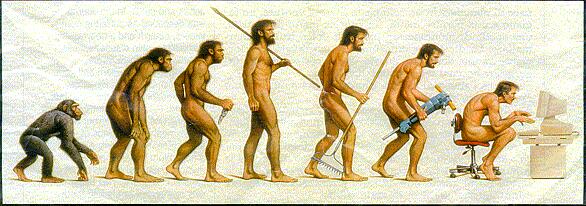
Tools and Technology are what separates us humans from the "lower" animals. I'm not entirely discarding the opposable thumb and language but even some greater apes and chimps have that. As do some humans who fall a shade shy of the intelligence of these anthropods, but that's a separate story.
It is our inventions (be it oral or written language, guns, pacemakers, mechanical ploughs, electricity, ipods or cars to name just a few) that enable us to enjoy the pleasures of a relatively secure modern life. Want to open a can, there's a can opener for that. If you're really rich or lazy or both, Walmart will even sell you an electric variant so that all you have to do is eat and become lazier. Or, if you do feel guilty and want to beef up or slim down, hit the machines in the gym.
But the biggest, brightest advancement of all is definitely the computer. It is now easier than ever to communicate with friends and family across the globe. Distance has virtually no impact; photos, videos and emotions flow freely, building bridges and connecting people; documents, information, finances are a breeze: a click here, a type there and viola the microseconds of modern magic, enough to marvel millions from a more mundane time for millenia, accomplish our tasks miraculously.
That is, untill your PC's hard-disk crashes.
Einstein once said, "Technological progress is like an ax in the hands of a pathological criminal."
[Image obtained from http://home.wanadoo.nl/lexbennink/GIFS/CARTOONS/cartoon_computer_evolution.htm]
It is mind-boggling how dependent we have become on technology. It took a laptop crash to really bring it in to perspective. I lost all my cherished mp3s and pictures and tons of data. My addressbook was wiped out. I had some backups, but not all. It's taken me a good week to get back up and running at 90% of what I was earlier.
But let's look at the bigger picture for a moment. Most if not all critical systems today are computer controlled these days: power supply networks, air-craft landing and guidance systems, industry / corporate financial data, terrestrial traffic lights, phone switching networks, the markets, the Internet, communication / positioning satellites. All technologically advanced than just a generation ago and all intimately dependent on a critical, susceptible technology. SHUDDER.
And it isn't just the developed nations that are susceptible to this. No, not any more. The developed world might still have the most lose (can't imagine famine ravaged African countries to suffer an immediate loss just because one GPS satellite can't talk to a base station), but sooner or later everyone will be affected. And not likely in a good way.
I'm not hinting at an insane individual or a group intent on causing havoc. No, i don't think they are the biggest threat because ironically, they too need all this to function and survive now. And they possibly can't get totally around the distributed safe-guards and back-ups already in place. I'm thinking more of indiscriminate, potent natural events which probably offer no warning and no discrimination: e.g. solar flares and magnetic storms. Only nature can produce grand catastrophes of gargantuan scale. And despite our amazing advancements, I fear we are no where close to being ready for an eventuality like that.
Oh well, I'm just going to back up my data and hope for the best. CTRL + S.